Post-Human Crash: When the Human System Crashes
What happens in the precise moment when the boundary between the human and the artificial shatters? *Post-Human Crash* by GlitchAv attempts to answer this question not with a statement, but with an experience. This audiovisual work stages a collapse: an instant in which biological identity, algorithms, and digital matter collide and transform each other. The title evokes a system crash – a moment of rupture in which the structures that define the human begin to fracture, allowing something different to emerge.
A Face That Shatters and Reassembles
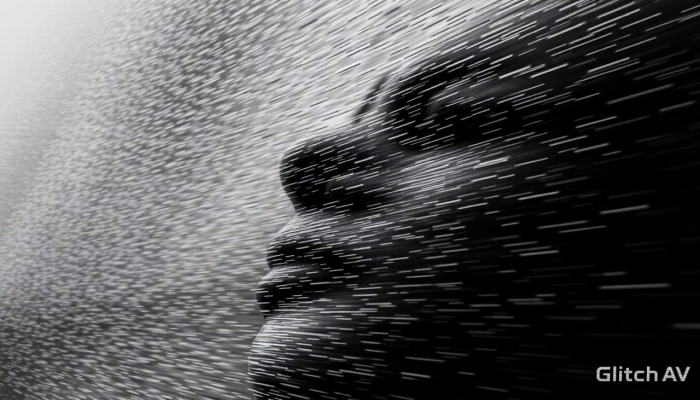
At the visual core of *Post-Human Crash* lies a female face in close-up. Yet this face never stays still. It transforms, fractures, and reassembles in a relentless cycle. Fragments of code scroll across the background and at times seem to graft themselves directly onto the skin, as if invisible digital structures were running through the body.
At certain moments, the face explodes into a multitude of luminous fragments. At others, it reassembles through a morphing process, but each time in a slightly different form. There is no definitive version. Every reconstruction is merely a temporary configuration. This continuous destruction and reconstruction generates the sensation of witnessing a permanent mutation, as if identity itself were an unstable flow.

Human or Something Else?
The work does not provide an answer to the question that inevitably arises: is that face human? Is it the anthropomorphic representation of an artificial intelligence? Or a hybrid of the two? The viewer is left in this ambiguity. The face becomes a projection surface, a space in which the natural and the artificial merge without a clear solution.
The Music of the Crash: Negative Harmony and Algorithmic Glitch
From a musical standpoint, *Post-Human Crash* arises from the encounter between two profoundly different sonic worlds. On one side, a chamber ensemble composed of vibraphone, marimba, flute, and string quartet. The writing for these instruments is based on the technique of negative harmony – an approach that generates mirrored harmonic structures, perceived as familiar yet simultaneously unsettling. Negative harmony, theorised as the possibility of inverting every traditional chord around a central axis to create a “negative” counterpart, produces a suspended sonic fabric, almost fragile, as if the musical material were constantly on the verge of transformation.
On the other side emerges the electronic dimension, built through glitch elements, noise textures generated by an algorithm developed in Pure Data, and digital synthesizers. Noise is not a mere effect: it is a living material, generated by an algorithmic process that produces irregular, fragmented, and often unpredictable structures. Electronics become a sort of autonomous entity, capable of dialoguing – and sometimes clashing – with acoustic instruments.
The piece unfolds in two sections. In the first, the acoustic and electronic dimensions coexist in a fragile equilibrium: a dialogue that appears cooperative but conceals a constant tension. In the second, the acoustic component disappears entirely. Only the electronics remain. The system has taken over. The soundscape becomes more abstract and unstable, as if the machine were continuing the musical discourse autonomously.
Post-Human Crash: A Perceptual Experiment on the Boundary
Post-Human Crash is not merely an audiovisual composition. It is a perceptual experiment: an attempt to stage the moment in which the boundary between human and artificial ceases to be clear-cut. In an era in which algorithms, neural networks, and generative systems actively participate in creative and cognitive processes, the work raises a question that has no single answer.
The crash is not necessarily an end. It could be the beginning of a new form of existence. An unstable territory in which something new – or perhaps merely a deformation of what already exists – is emerging. The face that shatters and reassembles, the sound dissolving into noise, matter becoming code: all converge to outline a space in which the human and the post-human are no longer opposites, but two faces of the same, unstable, transformation.